
- The new Azvi Chair: Infrastructure and Construction Technologies will bring students closer to real projects, promote applied research and strengthen knowledge transfer between the university and industry.
The University of Seville and Azvi have established the Azvi Chair: Infrastructure and Construction Technologies, an initiative created with the aim of strengthening the connection between academia and industry, promoting applied innovation and contributing to the training of the professionals who will lead the future of the infrastructure sector.
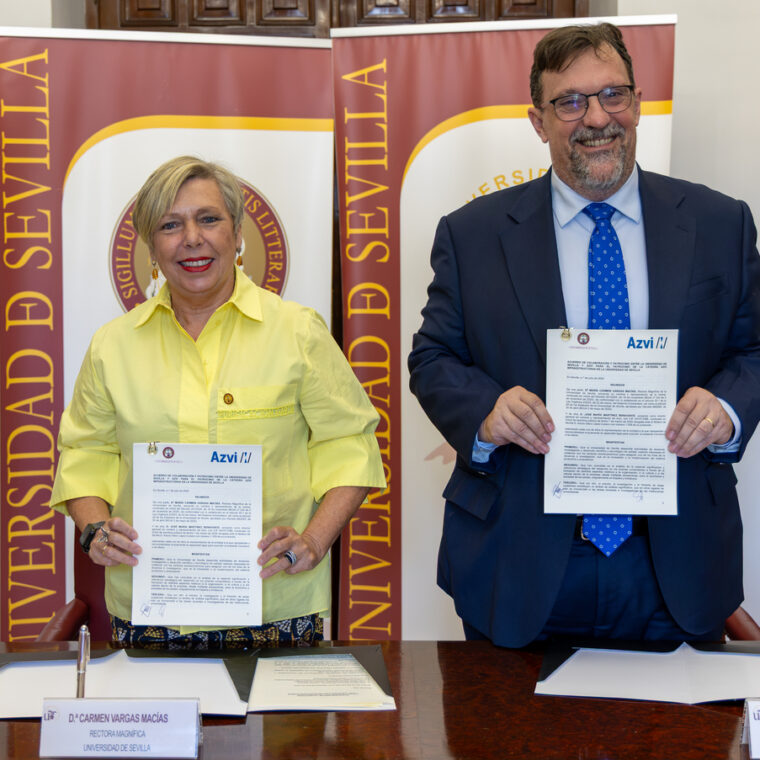
The agreement, signed by the Rector of the University of Seville, Carmen Vargas, and Azvi’s General Manager, José María Martínez Benavente, will enable the development of research projects, specialisation programmes and outreach activities focused on some of the main challenges facing civil engineering today, including railway and hydraulic infrastructure, the digitalisation of construction through BIM methodology, construction planning, energy efficiency and process optimisation.
The signing ceremony was also attended by Ángel L. Trigo, Vice Rector for Innovation, Knowledge Transfer and Entrepreneurship at the University of Seville; Andrés Sáez Pérez, Director of the Higher Technical School of Engineering; and Alejandro López Ruiz, Director of the Azvi Chair: Infrastructure and Construction Technologies. Also representing Grupo Azvi were Elena Crespo Castaño, Director of Institutional Relations, Communication and Corporate Social Responsibility, and Juan Jesús García de Pablo, Director of Strategy.
The creation of this Chair reflects a shared conviction: that innovation has a greater impact when scientific knowledge is connected with the reality of construction projects, and when universities and companies work together to anticipate the challenges facing the sector.
Learning connected to professional practice
One of the Chair’s main objectives will be to provide students at the University of Seville’s Higher Technical School of Engineering with a learning experience closely linked to the professional practice of engineering. Through internships, specialist seminars, site visits and participation in real projects, students will be able to complement their academic education with a practical understanding of the planning, delivery and management of major infrastructure projects.
This collaboration will also facilitate direct contact between future engineers and Azvi professionals, encouraging the exchange of knowledge and bringing students closer to the technologies, methodologies and processes that are transforming the sector.
During the signing ceremony, the Rector of the University of Seville, Carmen Vargas, noted that this is the University’s first Chair in the field of civil engineering. “We are confident that this partnership will bring many benefits to our School,” she said, highlighting that the agreement had been signed between “a company that originated in Seville and has grown into an international leader in its sector, and the University of Seville, where, as part of our commitment to internationalisation, we want to play our part and contribute to strengthening that international presence.”
The Director of the Higher Technical School of Engineering, Andrés Sáez Pérez, emphasised that the creation of this Chair “reinforces the school’s commitment to strengthening its relationship with industry through corporate chairs, a model that brings students closer to the business reality of our environment and consolidates stable lines of collaboration in training, research and knowledge transfer.” He also highlighted the significance of it being the school’s first Chair specifically focused on civil engineering and expressed his satisfaction at formalising this agreement with “a leading multinational in the infrastructure sector, with significant international reach and headquartered in Seville.”
A strategic partnership to drive innovation
For Azvi, the Chair also represents a strategic tool to strengthen its innovation capabilities and continue attracting highly qualified talent. Collaboration with the University of Seville will open up new opportunities for applied research, enable the validation of innovative solutions and accelerate the transfer of knowledge into the company’s projects.
The initiative will also facilitate the entry of young professionals with a strong technical background and a vision aligned with today’s construction challenges, helping to meet the growing demand for specialist profiles required for the development of increasingly sustainable, digital and efficient infrastructure.
“The infrastructure that will transform the world in the coming decades will require engineers capable of combining technical excellence, innovation and an increasingly sustainable and digital vision. At Azvi, we want to play an active part in that training, because we believe that talent is the primary driver of progress. This Chair has been created with the ambition of becoming a permanent space for collaboration between the university and industry, where academic knowledge and experience gained from real projects feed each other to generate innovation, promote applied research and prepare the professionals who will lead the future of the sector. We believe that the greatest legacy a century-old company can leave is not only the infrastructure it builds, but also the knowledge it shares and the opportunities it creates for future generations,” said José María Martínez Benavente, General Manager of Azvi.
Seville, a benchmark for knowledge and engineering
The Azvi Chair will also help consolidate Seville as a centre of excellence for engineering, innovation and construction technology, strengthening collaboration between universities and industry while creating an ecosystem capable of attracting talent, promoting research and providing solutions to the current and future challenges of the sector.
With this initiative, Azvi reaffirms its commitment to knowledge generation, applied innovation and talent development, in the conviction that collaboration with universities is one of the most effective ways to build more efficient and sustainable infrastructure while training the professionals who will make that future possible.