Construcciones Urales is carrying out the construction of Phase 1 of the Santa Martha station, part of the mass electric transportation system known as the Elevated Trolleybus. The project also includes the execution of a curved viaduct that will connect this station with Line 8 of the Trolleybus, coming from Constitución de 1917 station (Mexico City).
The project is divided into two phases, Phase 0 and Phase 1, due to the station’s location at the boundary between Mexico City and the State of Mexico, and therefore managed by two different administrations.
Once both phases are completed, the station will also enable the interconnection of the two elevated trolleybus lines that will converge there: Line 8, connecting Constitución de 1917 with Santa Martha, and Line 10, connecting Santa Martha with Chalco.
In addition, the Santa Martha elevated trolleybus station will form part of the Modal Transfer Center (CETRAM) Santa Martha, which, through pedestrian walkways, will connect to the existing transport systems: metro, bus, cable car, and elevated trolleybus.
Construction of Phase 1 of the Elevated Station
The construction of Phase 1 of the elevated station is developed across four levels:
- Street level – bus terminal.
- Concourse–walkway level, with a built area of 704 m².
- Trolleybus platform level, with a built area of 1,178 m².
- Roof level, with a built area of 581 m².
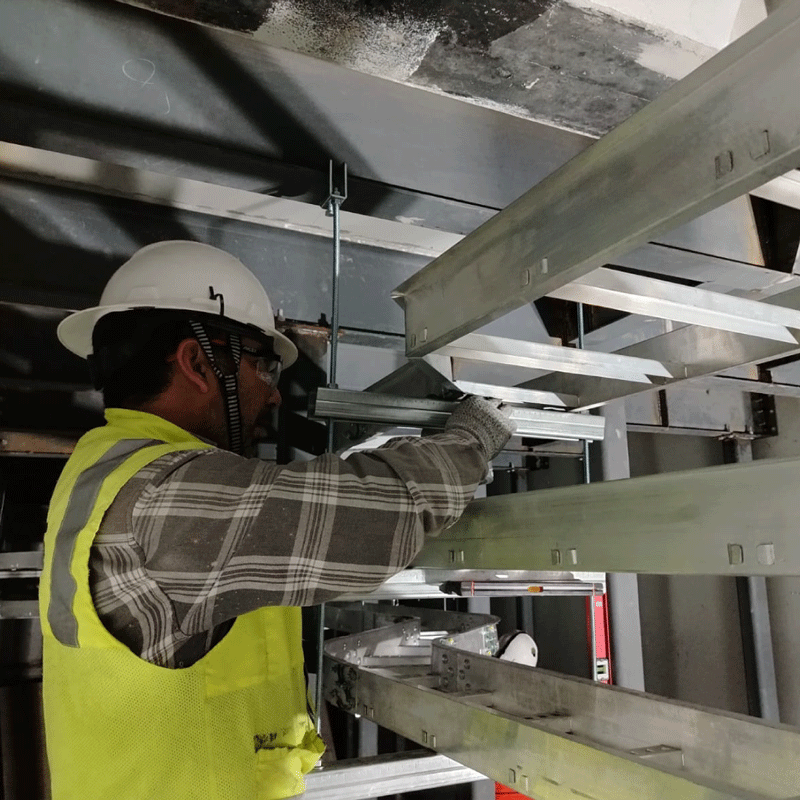
The structure as a whole is resolved with large reinforced concrete frames, made up of columns with a section of 2.4 x 2.9 m and variable-depth beams ranging from 2 to 3 m. These support the different elevated levels, which are executed with various steel structures.
These large frames are founded on reinforced concrete pile caps, 2.5 m deep, placed at –6.5 m below street level. The loads are transferred to reinforced concrete piles with a 1.5 m diameter and lengths of 67.5 m. The pile caps of the different frames are braced with foundation beams measuring 2 x 2.5 m.
Key figures for this work include:
- 878 m of piles (1.5 m in diameter).
- 2,977 m³ of structural concrete.
- 844,000 kg of reinforcement steel.
- 548,000 kg of structural steel.
Construction of the Curved Connecting Viaduct
The curved viaduct, which will connect Line 8 of the trolleybus with the Santa Martha station, has column heights of up to 15 m. It begins with a deck section wide enough for two-way trolleybus circulation. Shortly after, the deck splits into two narrower branches with one-way circulation each: the north branch and the south branch, both connecting to the station’s structure.
Both branches are also linked in the central area to allow for trolleybus direction changes.
- The north branch, 104.56 m long, consists of a hyperstatic structure with three spans of 28.21 m, 28.44 m, and 18.22 m, plus an isostatic structure of 29.69 m.
- The south branch, 76.82 m long, consists of a hyperstatic structure with two spans of 30.92 m and 18.44 m, plus an isostatic structure of 27.76 m.
The deck typology of the viaduct (both branches and the central junction) is mixed, formed by a 25 cm thick reinforced concrete slab over a steel box girder with a depth of 1.63 m. The deck rests on variable-depth caps connected to reinforced concrete columns of variable height.
The foundation of the columns is executed with reinforced concrete pile caps, 3.75 m deep, placed at –8 m below street level. Each support transfers the load to the ground through six reinforced concrete piles, 1.5 m in diameter and between 64 and 74 m long, depending on the support’s location.
Key figures for this work include:
- 373 m of piles (1.5 m in diameter).
- 479 m³ of structural concrete.
- 493,000 kg of reinforcement steel.
- 655,000 kg of structural steel.
Photos: Construcciones Urales.